
Chipata to South Luangwa National Park, September 2022
Camping on the Luangwa River
The scenery on the way to the national park is different from previous Zambian landscape with palm trees rising as Chipata falls away behind us. The road we are on is the same that would take you up to the North Luangwa national park although I believe a river crossing on a raft is potentially required.
We haven’t pre-booked accommodation and so we navigate using our trusty iOverlander app to a few places. Our number one choice recommended by others is Wildlife Camp but it is currently booked out. We book Croc Valley campsite for three nights and then Wildlife Camp for four nights when space opens up.
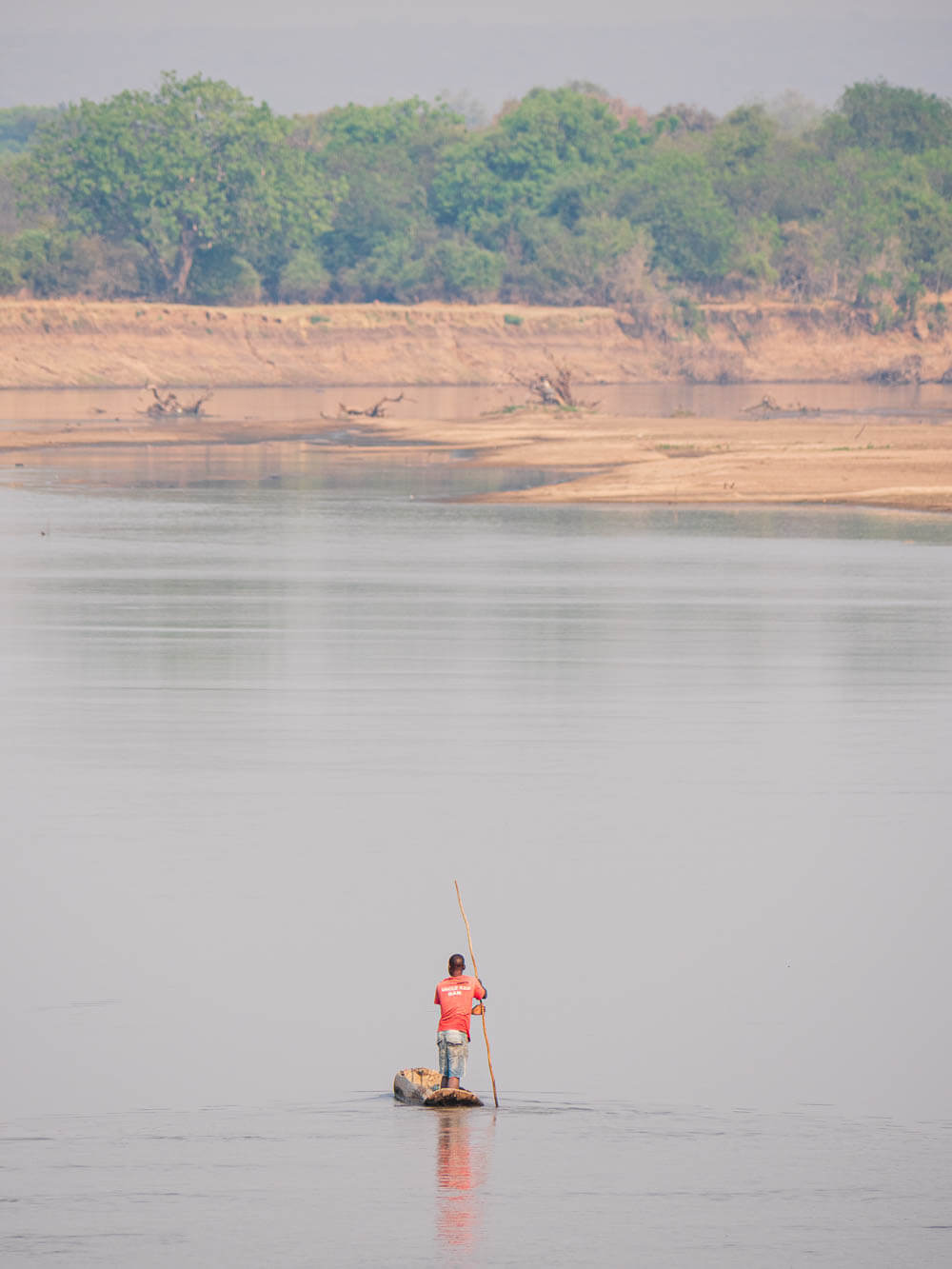
Croc Valley is right on the Luangwa river looking over to the national park. It also has a huge swimming pool and some decent melted cheese foods. We spend the three nights lounging by the side of the pool catching up on hobbies and enjoying the view of the river with hippo, crocodile and elephant. In the evenings we braai some excellent meat found at a shop opposite Tina’s grill in the nearby village and listen to the calls of the predators coming out from their hides at night.

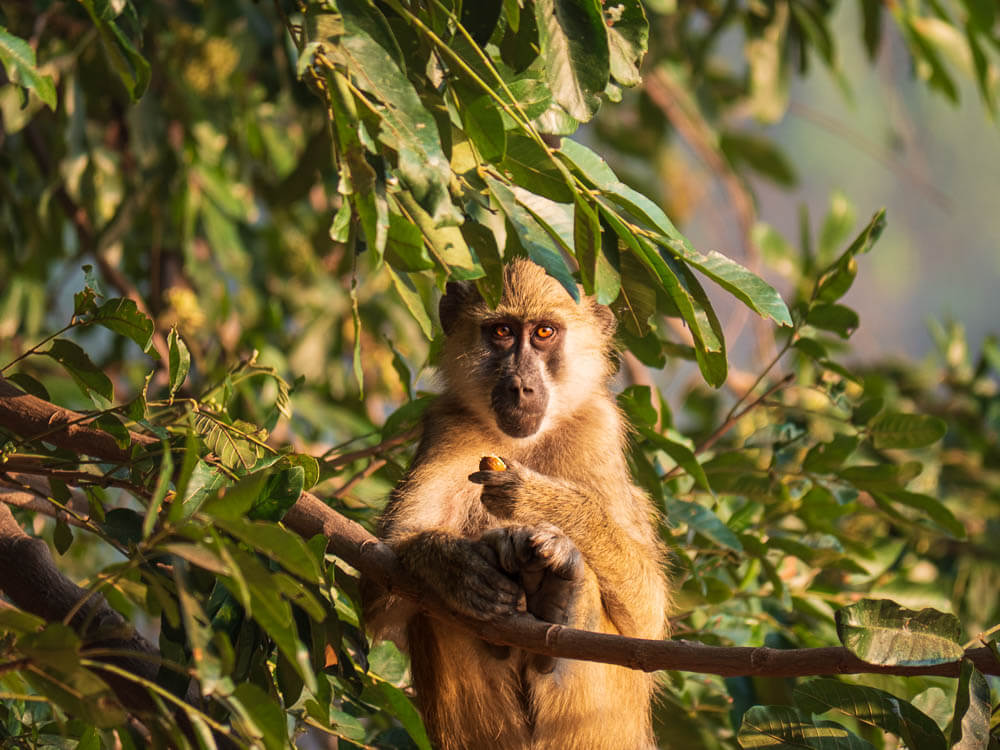

On the second night we are surprised by the sound of an elephant walking right by our tent. His footfall hits centimetres from the side of our ground tent. From our bedding we watch from the ground perspective a huge mastodon serenely pass by us. We hastily jump in the car and watch a small herd move through the campsite munching on trees. Still amazing that such large animals can be so quiet.
On our final night in Croc Camp, a European couple had the same experience as us except they were in a roof top tent and were eye to eye with the same big elephant for a good few minutes. The experience which made the trip for them I think.
Our major experience came a few days later at Wildlife Camp. This camp was recommended to us by my cousin and it was a great suggestion!
Wildlife Camp is a little further from the entrance to the national park but is on a major bend of the Luangwa River and game viewing from the campsite is very good. There is a large plain leading up to the river where herds of all types gather to nibble on bushes and drink from the river. Large pods of hippo gambol at the river’s bend just beneath our campsite while thornicroft giraffe walk by prettily. Elephant herds rush across the shallow banks of the river mindful of crocodile and their young ones. A panoply of antelope daintily feed on grass and small bushes on the plain in and amongst their befriended zebra.

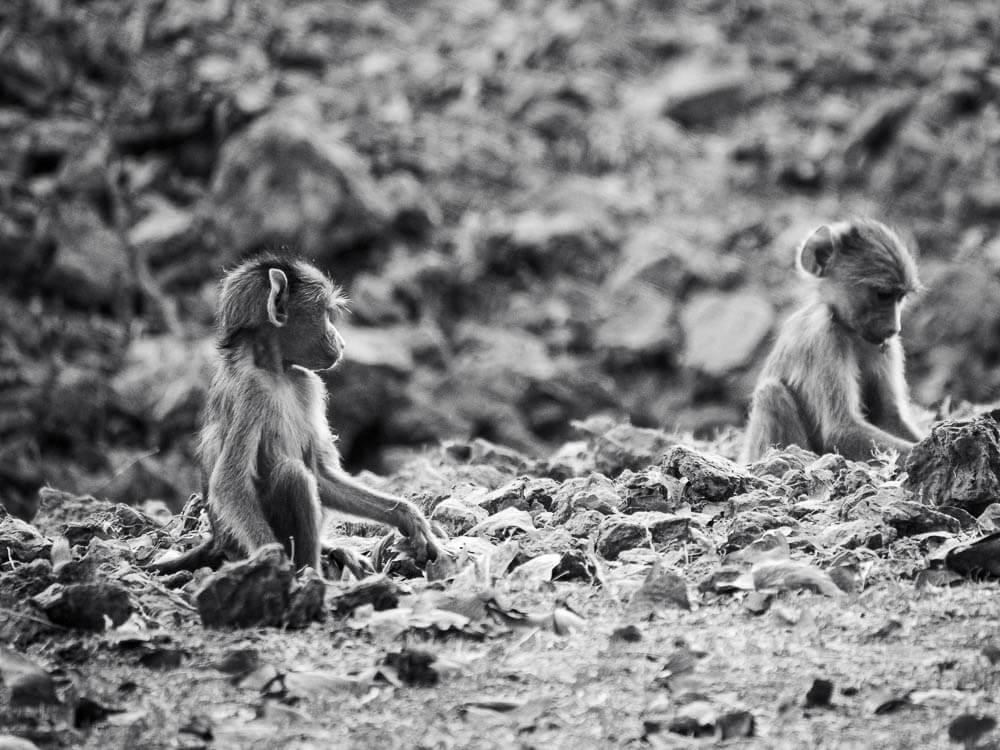
The second night of our stay at Wildlife Camp, we had another elephant walk by us and it dropped an entire tree branch on the roof of the tent. Luckily there was only minimal damage. That however was not our big animal story of South Luangwa.
Access to the South Luangwa national park is prohibitively expensive for budget conscious world travelers. The further north you go in Africa, the more expensive the national park experiences become until you are almost completely priced out in Tanzania and Kenya. Our plan is to minimise the cost and make some savings by doing a self-drive in the morning and then going on a Wildlife Camp safari vehicle in the evening for a night drive. The national park charges entrance per day so you can enter multiple times in the same day without spending more. I nearly never take the “goober” safari vehicle option but my cousin said the night drives are supreme in South Luangwa so we dutifully book for the evening of our second day at Wildlife Camp. Both the morning and evening drives will be supremely adventurous!
South Luangwa Morning Game Drive, Rare Sightings & Major Puncture
The wake up in the dark of an early morning is easy enough as we’re excited for our adventure. We have pre-made all of our breakfast and snacking needs and all that is needed is to fill a thermos of “real coffee” and head off to the national park entrance gate. My partner insists on ground coffee while I could quite easily enjoy instant for the effort. We inject the caffeine and head off on our adventure. Through careful planning, we have pre-paid the entrance the day before and so quickly breeze through the gate formalities and head into the park only a minute or two after gate opening time.
I am interested in understanding the progress of Route 05 which runs through the park so we broadly stick to the main road and go slowly looking for any felicitous early morning sightings.
In a fairly short amount of time we are surprised by an entire pride of felicitous felines. As driver, I am so not expecting the sight that I don’t even notice the three lionesses until we are almost on top of them. Right on the side of the dirt road are three lioness lazily enjoying the first rays of the morning sun. Their bellies look full but they are not engorged. There also happens to be a video camera man in an official vehicle recording them. We nod to each other from our vehicles and we turn to give the camera and ourselves good views.
The pride of three lioness appears to be five with two more further into the long grass and thorn trees. There is no male lion lion apparent but that is not unusual as he will often be off nearby lazing by himself or further away on a sojourn. We sit and watch the pride for about about a half hour and then head off as they seem to only be getting less active after a busy night.
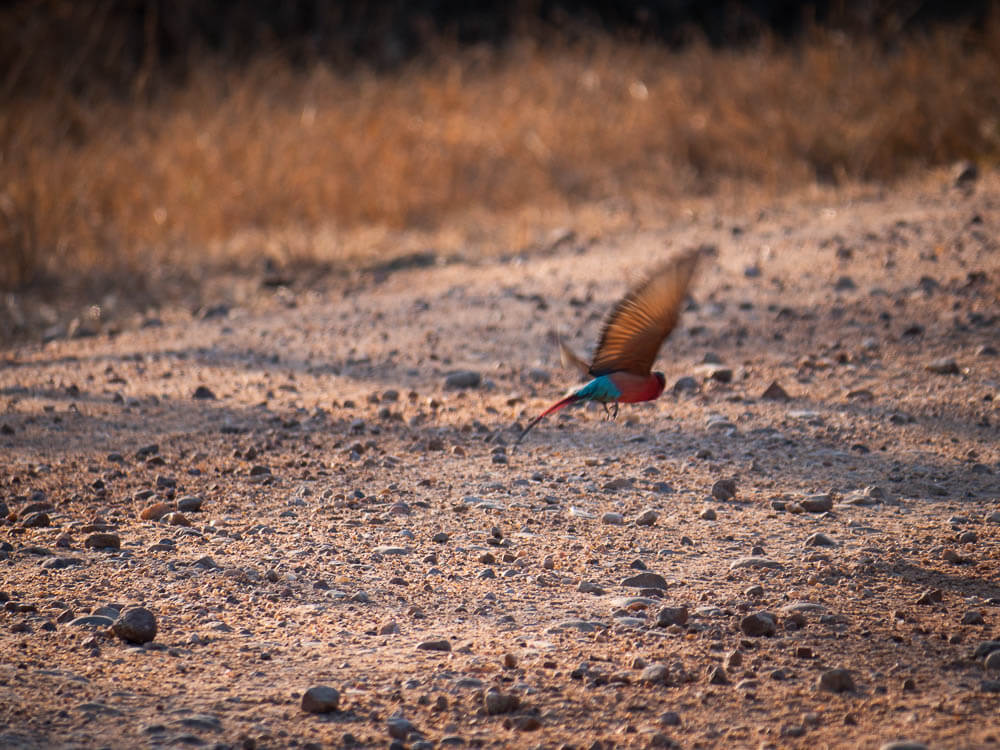


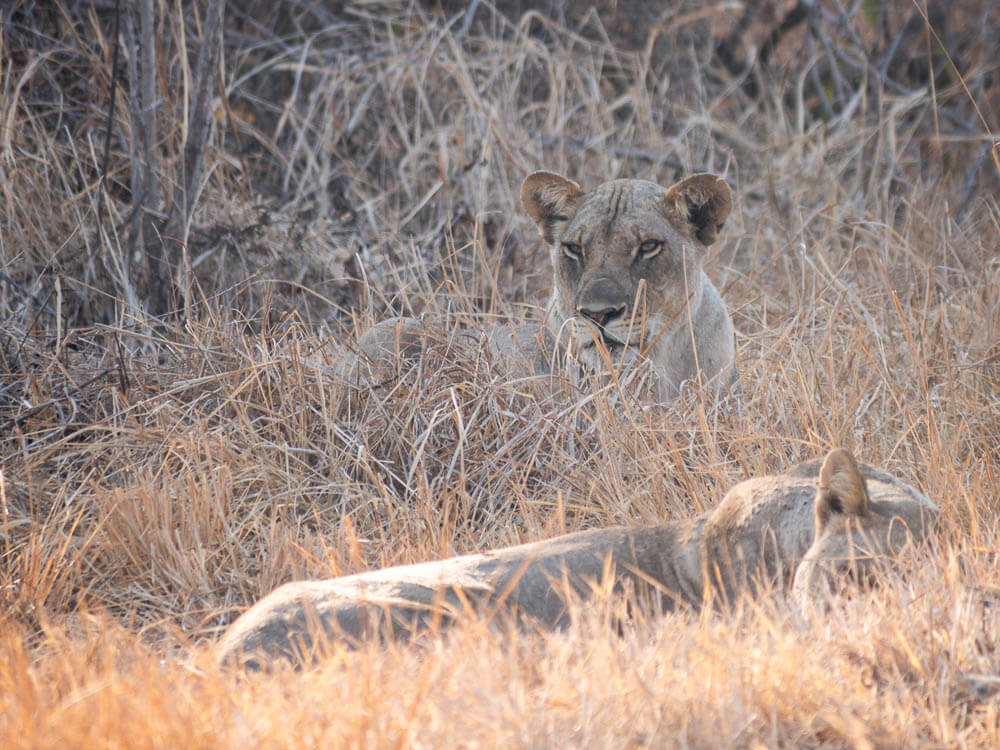
By chance, we will see this pride of lion again tonight in one of the most gruesome and spectacular sights we have witnessed to date.
After the pride of lion we head into the mopani forested area to investigate the opening around the safari airfield. There just might be something relaxing on the open field. We have been driving with the windows down and are quickly inundated by tsetse fly as soon as we enter the mopani tree zone. The sheer number of them is overwhelming. Even when we take the windows up, we still have one or two coming in through the air conditioning somehow. Some of them stick to our windows and windscreen peering in at us with malevolent presence. The experience really brings home the difficulties peoples must have endured living in and transiting through these areas.
The tsetse fly area is unpleasant so we head out after briefly ambling past the airfield area. Heading north and we are struck by the quick change from mopani woodland to miombo woodland. I assume it is miombo woodland but we are just below the muchinga escarpment. First, the tsetse completely disappear. Second, the trees are as opposite as might be possible. Miombo is a type of woodland which includes a variety of tall trees which are to a large extent evergreen. They can be found in the central zambesian zone (supposedly beginning above the escarpment) which extends into the DRC. The trees are tall with large and broad limbs and only grass and small shrubs generally grow beneath. Think the beginning of the forests of Tarzan and you are maybe getting the idea.
The assumed Miombo is so beautiful that we almost forget about the animals and just enjoy driving slowly through the surreal landscape. There are lots of side routes to explore which take us to the banks of the Luangwa river a few times. Even without the active animal watching we still see large herds of buffalo and puku, a fairly rare sighting in most national parks and they are just about everywhere. We also run into the very rare and unique thornicroft giraffe and crawshay zebra with very little effort.


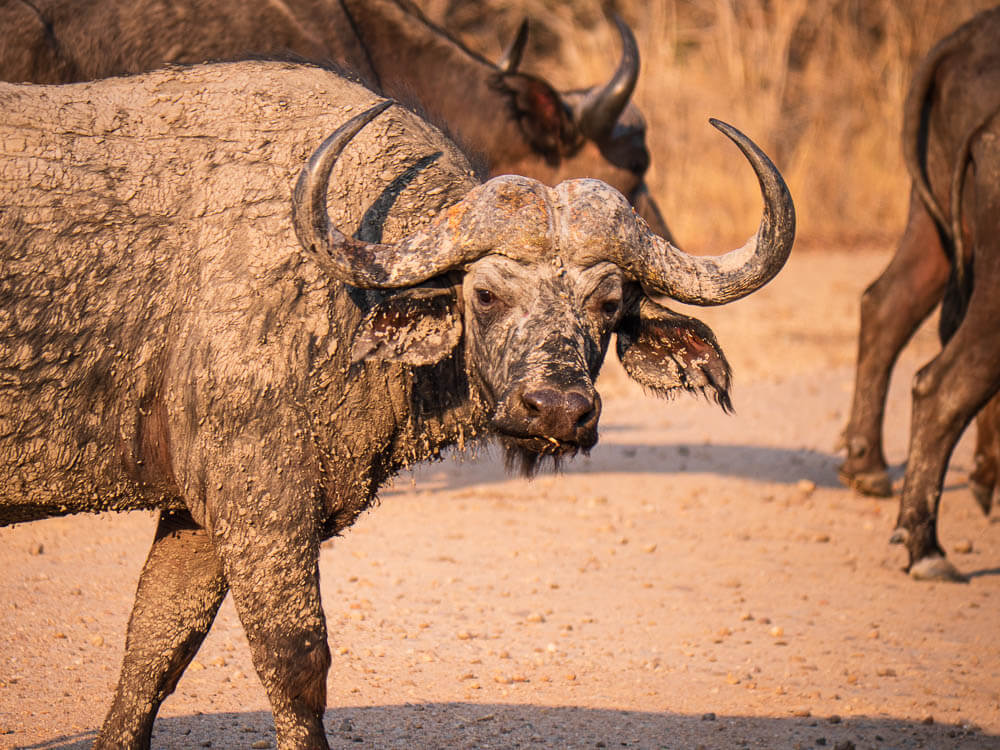
At the furthest point on our drive, we get a major puncture. It is definitely a major puncture when you can here the dramatic hissing from within the cabin of your vehicle. We are parked near to a small lake (Chipela Chandombo) and have been watching some hippo playing just on the other side of the small lake. I quickly reverse the vehicle away from the lake into a fairly open little spot beneath the tall trees and jump out to take a look after both of us carefully scan for animals. My traveling companion keeps lookout while I take a look at the tyre. Even the most careful watchers will often struggle to see a lion only a few metres away!
There is a large, almost cartoon caricature, thorn embedded in the front left tyre. It has lodged at the very highest point of the side wall just below the standard tread. I reach to pull it out but then think better of it and grab the tool box from the canopy. I have a small hammer which I gently tap the thorn with. The hope is to seal the hole with the culprit which made it. No luck! The hissing only gets worse and after a few more taps and turns of the thorn I decide the puncture repair kit in the middle of the wilds of Africa is the only thing which is going to work. I definitely don’t feel like changing out a tyre with the spare considering the situation.
We have the ARB puncture repair kit which I have barely examined to date and only generally understand the technique. We also have a Viair air pump which runs off the vehicle battery.
After reading the repair kit instruction manual. I pump the tyre up only slightly with the thorn still in, pull the thorn out with some pliers and then quickly jam the pre-prepared sticky composite deep into the hole. I twist the plunger out and am surprised at how effective it instantly is. Nice! We just saved ourselves in the middle of the jungle!
A quick further pump up of the tyre and we throw everything into the cab section. I grab a cold coca-cola from the canopy fridge to celebrate before dutifully “remaining in the vehicle at all times.”
We have now spent a few hours in the park and so, mindful of the quick patch repair on the tyre, we drive slowly out of the park to rest up for the rest of the day. We still have an eventful night drive to look forward to in the evening coming.
South Luangwa Night Time Game Drive, Wandering Hippo’s & Gruesome Lions
My cousin told us that we had to do a night drive in South Luangwa national park and so this has been dutifully booked with Wildlife Camp. We made the booking with Wildlife Camp because their prices are competitive and it’s obviously much easier to go with the operator from the same camp as yourself. There is a very strong expectation at many of the camps at South Luangwa that you will book safari drives with them rather than competitors. Some tourists report some fairly aggressive behaviour from some of the camp operators. Luckily, synchronicity worked in our favour here but to be honest Wildlife Camp never pressured us on this point in any way.
We are picked up from the campsite in the late afternoon and head off into the park. We have already paid our entrance fee to the park for the day and hand it over to the guide. A few minutes and we’re in the park in an open top safari vehicle. We have won the back seat which is highest. So we’re the cool kids. The rest of the group is made up of european and american enthusiasts.
The safari guide is the driver and his assistant will hold the spot light when the light goes down. It’s an enjoyable early evening drive and we spot a large herd of buffalo and find some thornicroft giraffe in a “Serengeti” type area of the park which is idyllic and surreal to the extreme. We watch the sunset from the bank of the Luangwa River while sipping on a cold drink and chatting with the other passengers.
The guide asked what everyone was interested in seeing and the europeans and americans unequivocally said “cats.” The second part of the drive after the sunset is therefore devoted to hunting down some cats. The guide is on his radio often. Apparently the safari operators share information with each other which results in some prime sightings. I’m uncertain whether the “sport” of the safari is lost a little in this but it’s quite fun dashing around calling out to other vehicles on their sightings along the way. There are probably about ten other vehicles in the area all dashing madly around trying to find the elusive cats and other big ticket animals.
Under the sausage trees we find a hippo every once in a while munching comically on the fruit in the spot light. We also find a crocodile disturbingly far from any water source, trundling through the bush. I think we all reflect on our own personal visits to ablutions at night and wonder if we’ve been attentive enough to the possibility of meeting reptilian camp visitors.

The end of the night drive is obviously coming close and no big cats when there is a little more activity on the VHF radio. The guide moves quickly back towards the main dirt road and we start moving up route zero five. I take a guess that the pride of lioness we saw on our morning drive have been found.
We arrive to a bit of a melee of safari vehicles. I count around eight vehicles and we’re the last to arrive. Three vehicles are on the north side of the scene on the road. And the remaining four are fanned out with two of them sitting on the side of the road. All of the vehicles have turned their engines off and some are pointing lights at the pride of lioness in front of us. There are three lioness that we can see standing on the right hand side of the road looking down a large culvert. Our guide breaks to the right and parks well to the side of the furthest vehicle.
In front of us, we can see the large pipe under the road and a fourth lioness standing in front of it. What happens next occurs in rapid succession. Two of the safari vehicles have heavy contingent of connected families joking with each other and children cooing. The scene is a little noisy but not obscenely so.
To my dying day I will swear the the three lioness had a little chat in front of us. After some head moves and growls one of the lioness separates from the three and stalks off to the left hand side of the culvert. The lioness sitting in front of the culvert on the right hand side has already moved to the side and is nestled in the long grass. Whether through coincidence or not, one of the safari vehicles turns off a spotlight on the left hand side and the stalking lioness at that moment launches with a bone screeching roar through the underground tunnel.
Instantly, the largest warthog I have ever seen tears out of the tunnel on the right and shoots through the grass and between two small trees. The warthog is screaming and so are the children in the family group. In the first few milliseconds I think the warthog might make it but out of nowhere a fifth lioness springs out of hiding sending the large warthog directly at our vehicle! Only a few metres away from us, less than a second from the warthog heading under our vehicle, the fourth lioness jumps on the poor warthog from behind and the fifth instantly has the warthog’s neck.
The cries and screams of the warthog take longer than expected to die away even with the throat hold and the lioness tearing at the belly before the final rites are due.
There is now complete silence from the family safari vehicles. There is complete silence from everyone. I still have a can of mace I took out when I saw the warthog and lioness heading directly for us. Not that it would have been necessarily useful. The safari vehicle with the children starts up, quickly backs up and heads off for some difficult bedtimes.

The remainder of us sit in awe for a while looking at the scene in front of us. The brutality and sadness of the warthog’s demise is heavy on my mind and I assume most of the other safari guests are having similiar thoughts. There is a deep silence with no jokes or conversations.
The drive back to the camp is quiet with only a few words from me to the game ranger at the gate who enjoys hearing of the excitement.
The remainder of our time in Wildlife Camp was spent lounging in the pool, doing our hobbies, cooking over a fire in the evenings and enjoying the fact that we had made the most of South Luangwa National Park.
 The Colour of Travel
Leave a comment