
Letlhakane to Maun via Kubu Island, September 2022
Granite Islands, Giant Baobabs and Ancient Cosmos
My geography and vehicle mechanic knowledge has never been very strong but I am learning my geography by traveling to places and vehicle mechanics by fixing problems as we go. To me, the Makgadikgadi Pans are maybe a dim memory of David Attenborough’s voice, a few rain drops splashing in slow motion on a dry and dusty surface followed by an excited zebra dashing somewhere.
To my surprise, I have now learned that the Makgadikgadi area is very likely to be a large part of the cradle of human kind. One of the major areas where homo sapiens first established themselves to the point of viability. Over 200,000 years ago the area was a fertile land of lakes and rivers where our early ancestors were given some space in which to grow, learn and develop the early skills needed to eventually circumnavigate the globe.
Many ages ago, around ten thousand years, the Makgadikgadi area started to dry eventually leaving behind a large area of salt pans. These shallow basins of white and salted sand have since filled only on an annual basis. The scant sources of water for the salt pans are the Nata River flowing from Zimbabwe, some minimal rainfall and, much less so, the Boteti River which flows from the Okavango Delta when in flood.
We are heading to Kubu Island. A small granite island sitting slightly higher than the vast surrounding plain of white sands of the now dry Makgadikgadi. Kubu Island sits primarily inside the south west area of Sua Pan. To get there you need to navigate between the two largest pans of the Makgadikgadi namely, Ntwetwe and Sua. Nxai Pan is seen as the third of the three largest but is further north. Kubu Island is outside of the Makgadikgadi National Park but is protected with the status of a national monument. It is considered to be a highly sacred and ancient site by the surrounding inhabitants and indeed many who visit the area. Some sources reference to ancient tool artifacts having been found dating back to before the advent of homo sapiens. There is also a ceremonial camp in the south of the island potentially dating to and linked with the people of Great Zimbabwe over 500 years ago.

The easiest route to access Kubu Island is the road entering from the south. We travel north from Letlhakane where Thuuthebe Camp is and deflate our tyres at Mmatshumo. A little while after leaving Mmatshumo you come upon an apparently random wooden viewing point. A wooden deck about three metres high. Well worth stopping and taking a look from the top as you are greeted with your first impression of the Makgadikagdi scrub land and white sands stretching to the horizon in front of you. After the view point, the route is fairly easy in the dry month of September with a few deepish patches of kalahari sand to either be avoided or drifted over.
The routes coming in from the north are longer and apparently more difficult with lots of dense scrub to deal with. Some routes in Makgadikgadi are completely impassable in the wet season and may remain difficult for some time after the rains. From my understanding, Kubu Island is impossible to approach in the rainy season (November to April). We did see a helicopter touch down on the pan near Kubu Island in early September.
We arrive at Kubu Island by midday and are greeted by unique monoliths of granite fingers and ancient baobab trees red in the striking sunlight. Another surprise from Africa and we are awed at our luck in being able to visit another natural wonder. We are the first visitors of the day to approach the island caretaker. A friendly person, the caretaker tells us to choose any campsite and we pick the one she recommends facing north and to the expanse of Sua Pan.


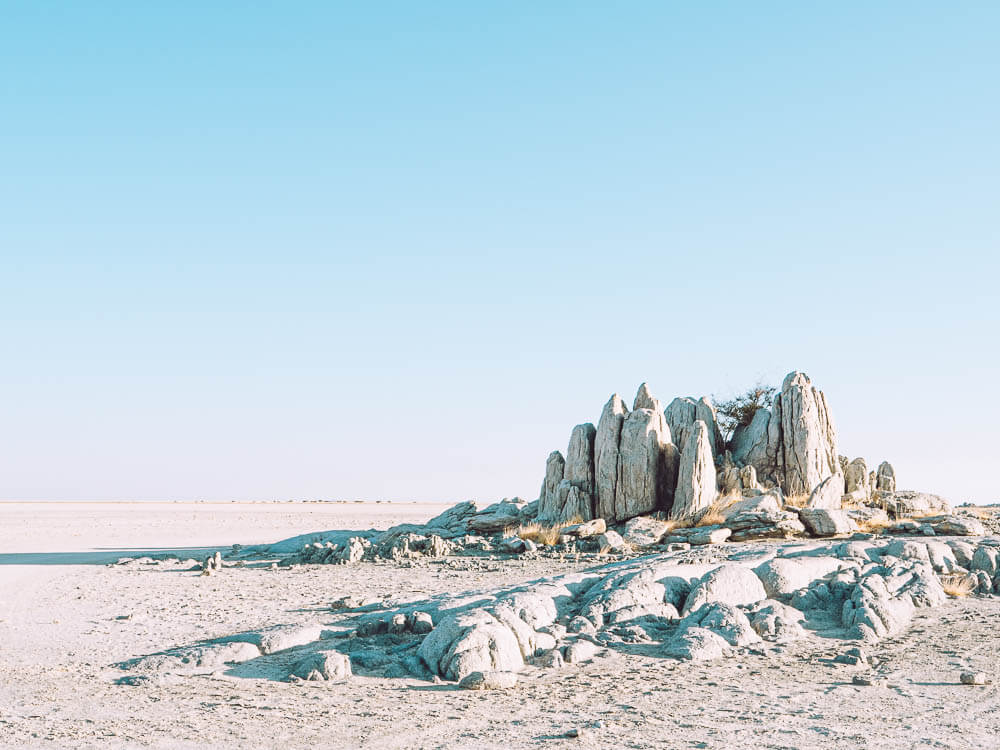
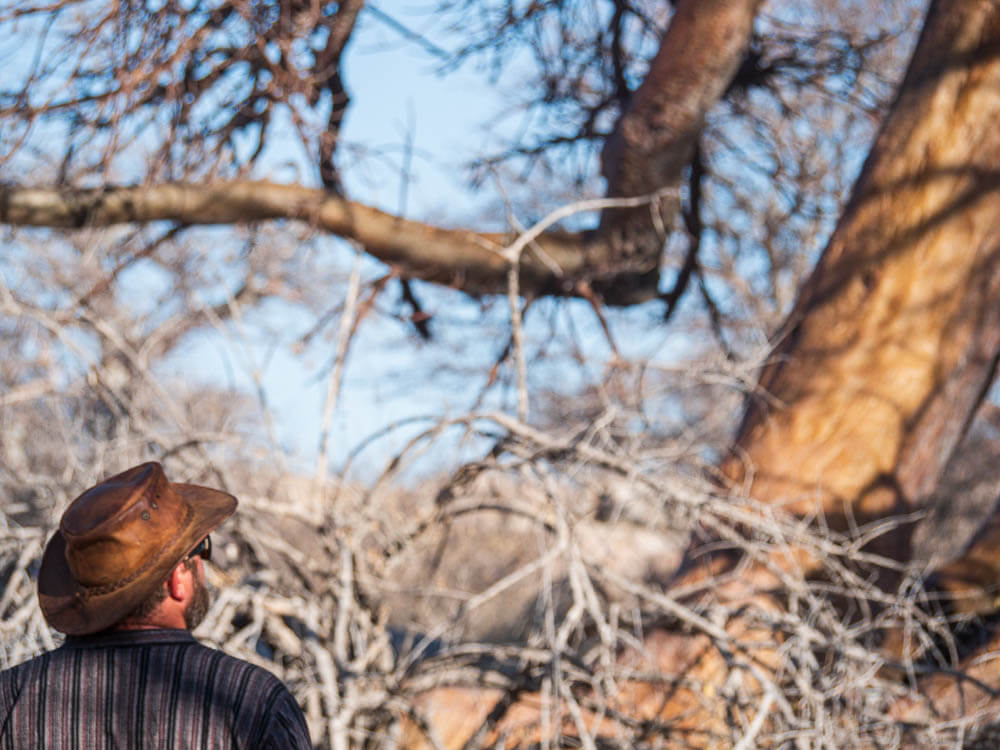
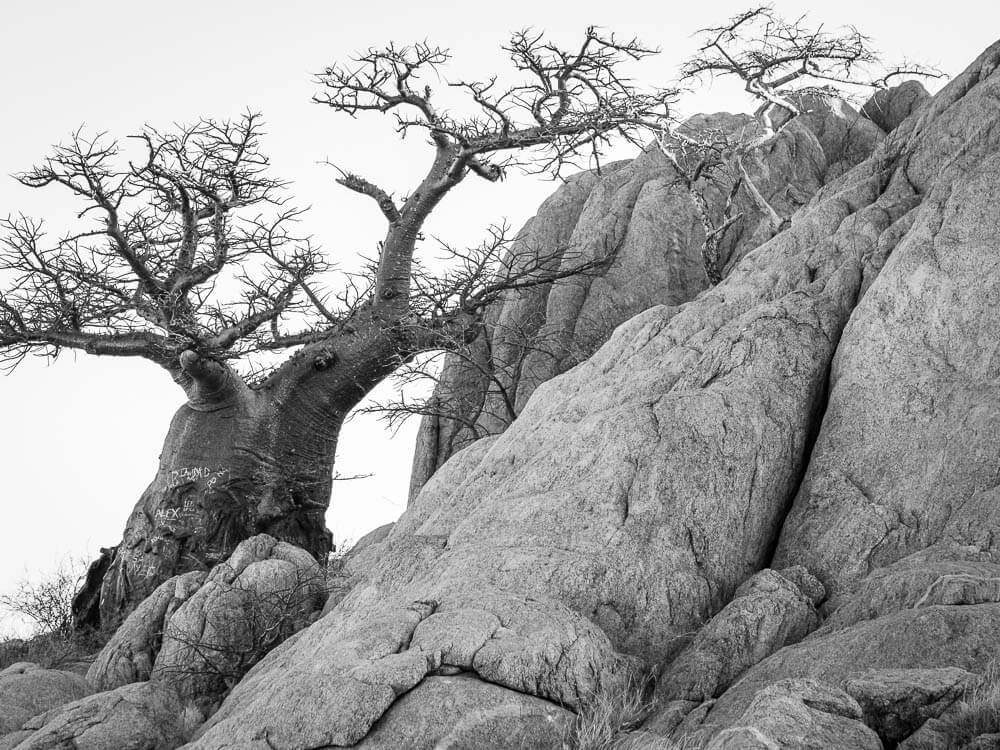
Camping on the other side of the island is not allowed due to the sacred nature of the site. The island is community run. Another one of the excellent and successful community initiatives that Botswana appears to be able to do so well.
We spend a few hours walking over the island gaping at and exploring the thousands of years old baobabs amongst the billions of years old granite projections. We find lightweight stones of shining black, green ancient course stones and a collapsed cavern used by potentially a millenia of medicine people over the ages.

That evening we sit by the fire and watch the stars and planets form and glide over the moonlit Makgadikgadi.
Eventually maybe we will leave our solar system, spheral-navigate our galaxy and then the universes beyond. Sitting in the Makgadikgadi staring up at the unblemished night sky with this knowledge is indeed an epoch spanning experience.


Maun, Admin & Alcohol Deprivation
We leave Kubu Island returning on the same road to the south. We have made the practical decision that we are overlanders and not off-roaders. We therefore look to pick the easier rather than more technically difficult route if we are not going to miss out on too much in the process. We notice all the Hoodia cactus in flower on our route out.
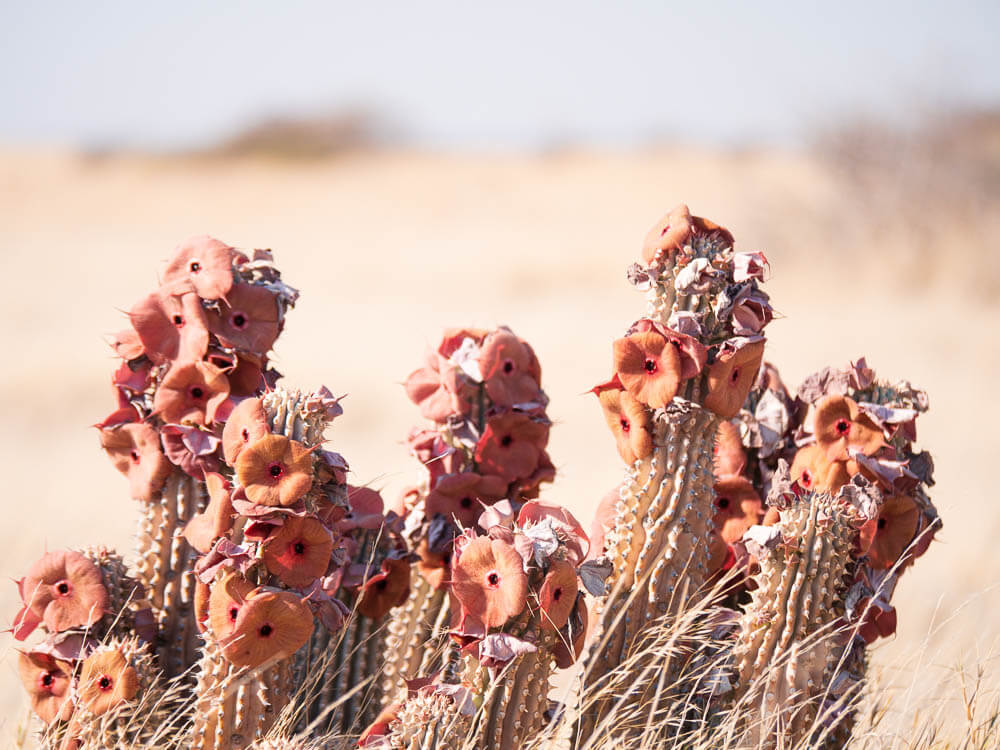
Our route is back to Mmatshumo and then along the A30 through Orapa until eventually meeting up with the A3 heading west to Maun. Our plan is to re-stock and then head into the Moremi – Khwai – Chobe areas. We are however made to turn back from Orapa and take a small detour as Orapa appears to be a sensitive economic mining zone. There are many potential stops on the way including Boteti River Camp where the large zebra herd migration is currently settled in early September. We are mindful of the fact that East Africa is the main objective and so we have to be painfully selective in transiting the countries along the way.
The Botswana zebra herds have been moving between the salt pans and the Botswana river systems for a long time. It is in fact the second largest migration after the Great Migration in Serengetti and Masai Mara. The nutrients in the Makgadikgadi marsh grasses are almost double those to be found in other areas of northern Botswana which is why they concentrate in the Makgadikgadi in the wet season.
The drive to Maun is spectacular and much different to the approach from the Botswana border in the south east and up. South eastern Botswana is flat and fairly monotonous with short and dry trees and shrubs as scenery for many hours. From the middle section of Botswana and up to the north the flat land begins to undulate a little giving some vistas of view over a timeless African landscape. Sitting on the edge of the Kalahari to the south west, there are a few villages and lonely looking homesteads with goats, donkeys and cattle somehow finding sustenance in a dry land. The Boteti River seemingly a life blood for these communities on the edge of the Kalahari.
Driving through this area during the escalating noises coming from Russia and the West makes me think of how these communities that still know how to survive on the land might be some of the few groups of humans to survive any impending nuclear fallout. The cradle of humankind again.
We arrive at Maun in the early afternoon and head to our favourite place to stock up, Riley’s Garage. Riley’s and the surrounding complex has lots of overlander equipment at decent prices, a cafe with cappuccino, a decent fuel station and a very good butchery called Beef Boys in the same complex. We fill up with chicken pieces, biltong and sausages along with caffeine and biltong (yes more) before heading to our campsite for the night, Audi Camp.
Audi Camp is a welcome relief after traversing much of Botswana in the space of just a few days. The camp is perfect with all of the facilities provided including a pool, bar and restaurant all along the side of the Boteti River. It is however still in the middle of Maun suburbia and so we use it as a rest stop only rather than a longer stay.
In the late afternoon while sitting in the bar area siphoning wi-fi I have my first and only pang for an alcoholic drink as I watch an intrepid bush explorer with beard and wide brimmed hat happily carry his large glass of tap draught beer to his table with a view. The heat of the day is producing rivulets of condensation on the icy cold fluted beer glass.
As in Mozambique, I have gone cold-turkey on any alcoholic drinks, chocolate or franchise fast foods. This time I am doing it for 60 days instead of the 30 days I did in Mozambique. For those who enjoy indulgence, I highly recommend this method when traveling as it gives you space to observe your “needs” in the dry period and then enjoy yourself guilt free in the “wet”.
I promise myself that I will enjoy a large beer from the tap gazing out at some African vista at the end of this 60 days. Then continue to siphon the wifi as it will be the last we see of any internet for a few days.
 The Colour of Travel
Leave a comment