Tsumeb to Etosha National Park, April 2022
Early in the morning a few days after the big rain we head in to Etosha National Park. The park is about an hour away from Tsumeb if you enter from the Namutoni gate. We are very excited. This is one of the more well-known and historic national parks in southern Africa.
The entrance gate is guarded by Namibian military boots and we’re warned not to take any weapons or plastic packets into the park. I am asked sternly whether we have any plastic packets. I shake my head and wonder dully on the logic of plastic packets bans but never the wrappings. My bag of peanuts as much an offender as the plastic carrier bag.
Responsibility for national parks in Namibia is shared by NWR (Namibia Wildlife Resorts) a public company owned by the Namibian government and other branches of the government who carry guns. I found the guys and girls with the guns to be generally unpleasant and sometimes rude. The NWR crowd on the other side of the gate are really nice, informative and professional.
We enter through the Namutoni entrance gate and struggle to figure out which building to go to for our daily permit. After ten minutes of wandering around we’re informed by the same gate guard that we need to drive a further few kilometres south.
The doctor in Tsumeb who prescribed me the rabies vaccine told me to try out a watering hole in between the entrance gate and Namutoni camp so we turn off to check it out. There is a massive bull elephant by the pan with some giraffe and zebra which is ideal. There isn’t the hyena that the doctor said will often be found there. In fact, we never saw hyena at that watering hole our entire stay but it was definitely one of our favourites. The watering hole is called Klein Namutoni.
The rainy season in Namibia is from November to April and we have arrived in the park in early April (2022). Many African land borders are also just starting to open up from the Covid pandemic after having been completely closed or requiring expensive Covid testing on each crossing. Etosha National Park, one of the more famous national parks in the world, is almost empty! It is a real privilege to be able to visit the park like this. We feel definitely guilty for the national parks and their staff struggling to make money but… hey, we’re here and we’re paying so might as well enjoy the wide open spaces.
After a brief stop-over at the watering hole (it’s just before Dik-Dik Drive) we head to Namutoni Camp for our day passes. We get passes which cover us for a few days. Note to intrepid adventurers: do not try to leave the parks without a valid day permit document showing validity for the entire stay. Again, the people with guns are pretty grumpy and probably don’t work in the tourist area because they didn’t get good marks at school. It’s a good idea also to have receipts for where you camped in the park as they might suggest you were wild camping.
After a brief stop at Namutoni Camp we head down the road to see if anything can be found in the early morning. We are greeted by a vast plain of grass and sporadic scrub stretching out in front of us. All of a sudden we realise we’re in one of the truly unique and legendary areas of our planet. On the vast plain are herds of blue wildebeest, zebra, oryx, red hartebeest, black-faced impala and springbok. Warthog run in between in their pods and eagles and vultures soar in the thermal climes above us.
We’re silently taken by the sights all around us and move slowly through the scenery starting just short from Namutoni Camp. We take a left branch track from the main road and see two cars parked ahead of us. A third car is coming in our direction and we’re told by the driver that there are lion ahead.
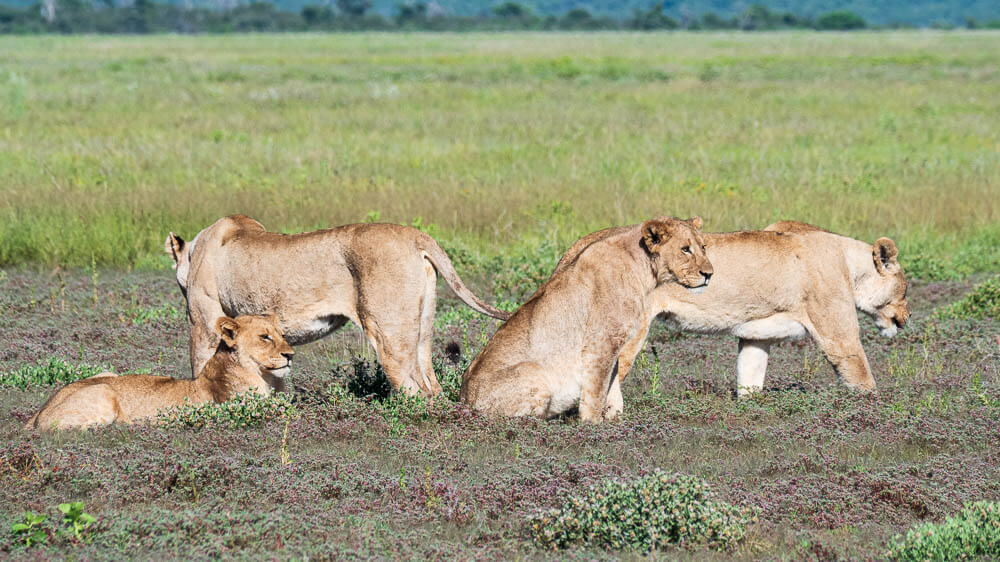
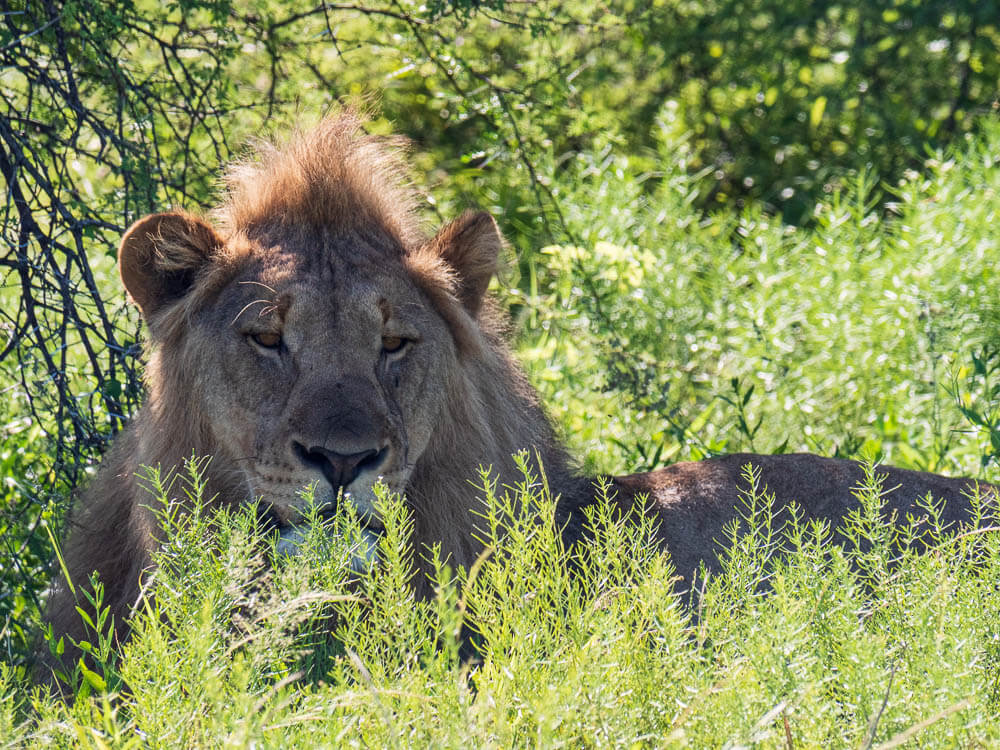
There are lion! Within an hour of being in Etosha National Park we watch a pride of lion resting in the Etosha grasslands. They are fresh from a night-time excursion. The lion are very close to the track and stay in place for an hour or more. There are a few young lion and the rest are made up of lionesses. No sign of a large male lion until we decide to move on and Kirsty stutters trying to share some important information with me, but failing somewhat. She just points. A large male lion about 10 metres away from us lazily lolling under the shade of an acacia tree. We completely missed it as apparently had the other tourist cars looking at the main pride. We spend ages watching the maned beast until a large overlander bus arrives and we decide to move on.
Some people travel in overlanders across Africa. Overlander bus’s are generally large trucks with high vantage points and reinforced windows. We saw a few of them along the way and I think they look like an excellent option for people short on either planning time or driving ability. We saw one overlander filled with only pensioners. Not a bad way to be spending your retirement.
The next surprise is the Etosha Pan itself. Stretching as far we can see, a hazy flatland of white cracked clay curves a horizon in front of us. For an unknown reason, a lonely oryx traipses across the scenery leaving an infinite trail of hoof prints behind.
The Etosha Pan is one of the largest natural examples of its type in the world. The Etosha Pan differs from the Makgadikgadi in that the Etosha does not fill significantly from feeding rivers. Instead, the Etosha sometimes holds a shallow layer of a few centimeters of rain-water. This thin layer of liquid is heavily saturated by the natural salt minerals present in the stark white clay of the prehistoric basin. At the end of the rainy season (April 2022) the Etosha Pan is already as dry as a desiccated jaw bone. For hundreds of kilometres around there is a stark absence of anything until the land rises slightly and mid Autumn grasses fed by recent rains sweep across the plains to the edge of an endless nation of mopani trees.



Excited by the panoply of wild animals and the endless distance of the famous pan alongside us we head down south slowly for the day. New additions of elephant and even a rhino appear in the distance. Half way down the length of the pan we take a left towards Halali camp. A few minutes in we find a white rhino moving quickly through the mopani trees and drive alongside him in the gathering dusk.
Halali Camp is my favourite camp that we stayed at in Etosha. We did however only see Namutoni camp (North), Okaukuejo camp (South) and Halali camp (mid-way) and there are others which are either non-camping or away from the pan. Halali camp has the largest swimming pool, the cheapest restaurant and is also less busy. It is the furthest camp from any of the entrance gates. We enjoyed camping in Halali for a few days doing game-drives in the early morning and late afternoons, but lounging poolside in the midday heat. The heat during the larger part of the day is significant even in Autumn and plenty of water bottles are recommended to avoid dehydration.
There were adequately stocked but very small shops in each camp. Don’t expect fresh vegetables.
The grassy plains of Namutoni (in April 2022) with the surrounding waterholes in the mopani clearings are best for spotting herds of various antelope and zebra, predators like lion and hyena as well as elephant. Quite a few other visitors who have written their experiences suggest that the rhino and elephant move up to Namutoni well after the rains have dissipated (June onwards). We did hear tales of very large herds of elephant between Namutoni and Andoni in the North in April. We are not particularly dedicated bird-watchers but there seemed to be a paradise of feathered creatures for twitchy types also. We did take note of kori bustard, swifts, blue crane, secretary birds, ground hornbill, martial eagle, bee-eaters and rollers. There is a large watering hole by the Namutoni Camp fence with seating which the intrepid can view from after the sun has gone down. You are only allowed to self game drive during the hours of light in between sunrise and sunset but there are official game-drives which will take you on a night drive for a fair price.
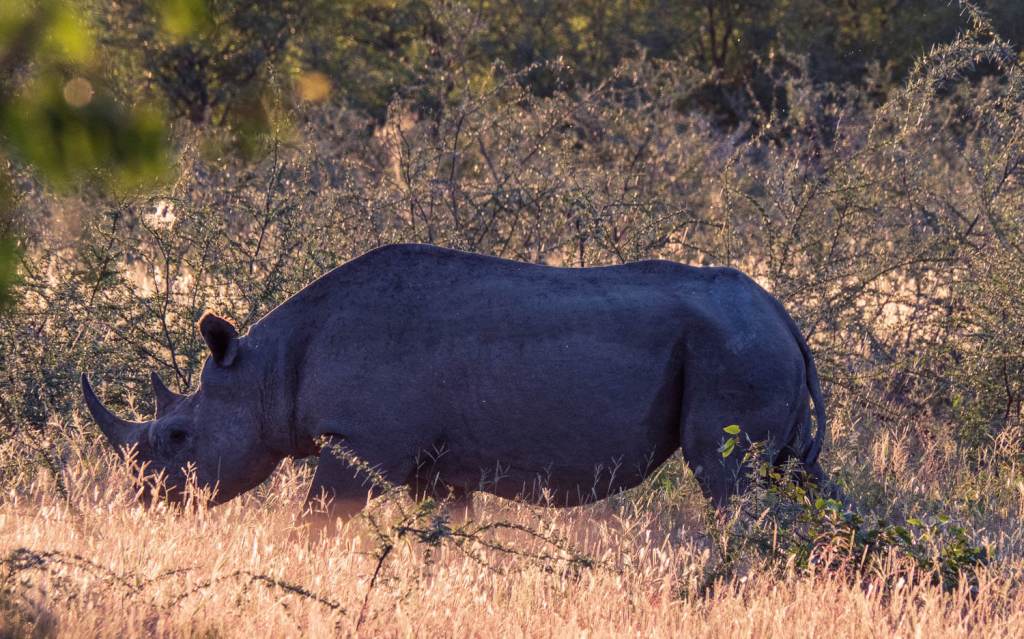
Halali Camp area and surrounds is a haven for rhino and we saw more black rhino here than white rhino which is not surprising considering the woodlands. Black rhino are of course a fairly unusual sight overall due to their endangered status and it was awesome to see a healthy population still existing in the Etosha. We saw on average two black rhino per day in the Halali surrounds. There are some beautiful waterholes spread throughout the Halali area but our favourite was Rietfontein watering hole. There is also a small watering hole right next to Halali camp called Moringa which can be viewed at night when everyone should have returned from their game drives. Moringa was not successful for us but will probably be of much more interest in the dry season when animals are forced to leave the smaller water sources deep in the park for the few that still contain moisture in the more game-watcher accessible clearings.

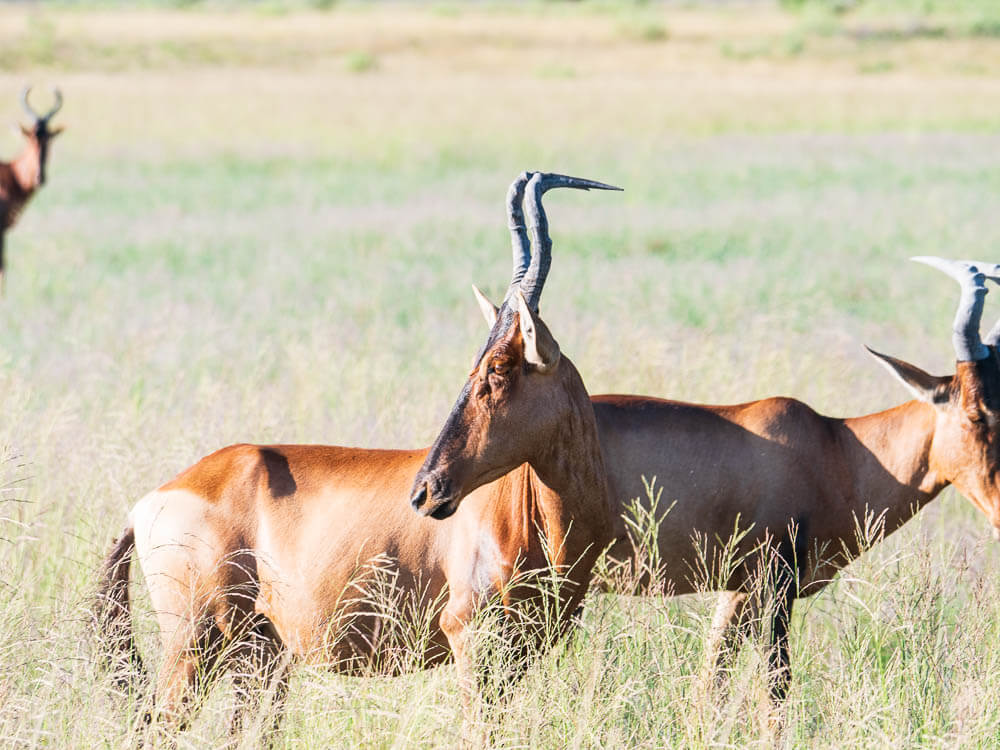


Okaukuejo and further West was investigated but the area is so dry and dusty we turn around after a few hours and head back to the lush clearings of Halali. The multi-day safari is ended by exploring in-depth the plains and lakes of Namutoni.
We were in the park for about a week. There was a discount at the time on accommodation for SADC (South African Development Community) passport holders but we did find the additional daily permit fee to be sapping our daily spend target. We didn’t find any multiple-day discounts or discount cards for NWR (Namibia Wildlife Resorts) entry permits.
There are some discount cards for accommodation options in Namibia but they seemed marginal in usefulness as you need to stay in only certain lodges/resorts. The various accommodation discount cards only appear to pay off after fourteen days or more of staying in prescribed places from memory. You have to pay an upfront payment for the discount card and then work it off slowly until you feel you have beaten the system.
I would suggest five days as a minimum for exploring Etosha and ten days plus would be ideal.
 The Colour of Travel
Leave a comment