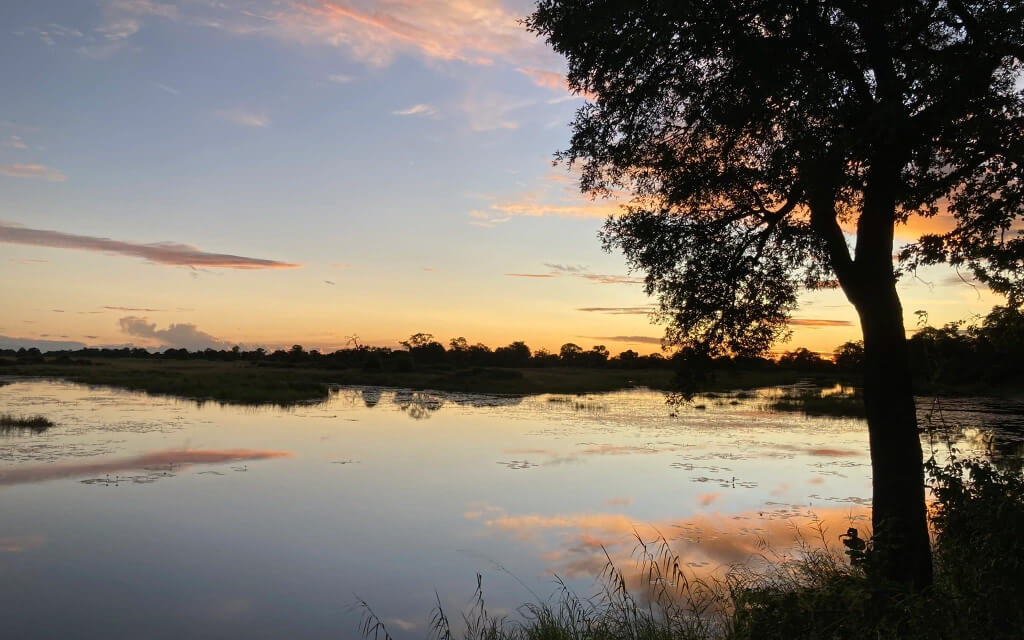
Divundu to Mudumu National Park, March 2022
The sun rises over the Okavango and I am itching to see what else there is to discover in the area. I convince Kirsty to pack up and grumpily leave our perfect little campsite. I want to see if there is another with some better fishing opportunities or maybe we can stay in one of the Caprivi Strip game reserves. I promise my traveling companion we will come back here in the evening if unsuccessful.
The Hilux plinks and plonks back over the bridge/dyke and we enjoy the scenery even more this time with the the sunrise. There are a few campsites along the way but none have the perfect on-the-river camp pitch that I have my heart set on. Maybe my expectations are too high but my patient companion agrees to do some more searching by crossing the Cubango river by bridge at Divindu and seeing what might be found on the north bank of the river.
Before crossing the bridge we stop in Divindu and pick up some groceries and sim cards. We’re now old hats at popping the new sims in and finding the best deal for data. Without exception in all southern African countries so far, we’ve found that buying one week’s worth of data and phoning or texting using airtime (money on the phone) is way cheaper than buying any of the package deals. You usually anyway leave an app running by mistake and before you realise it, you’ve used up all of your special package data and need to buy the weekly option anyway.
Divindu is a very small town. It has the basics that you will need but don’t expect to get anything more sophisticated than an AA battery and some essential food items.
We cross the bridge over the rapidly flowing Cubango and find ourselves at a military check-point. Namibia takes the defence of the Caprivi Strip very seriously. I’m not surprised. It is a thin strip of land running between Botswana, Angola and Zambia probably one of the more unique border shapes in the world. An incursion by a foreign power could cut off tens of thousands of square kilometres from Namibia. Illegal migration and poaching two other reasons for the strong military presence.
We get waved on by the soldier with the large automatic rifle and find another lodge on the Cubango river but again are disappointed by the option. This time the available pitches are looking on to tall reeds in a marshy section of the river. The Poppa Falls visible in the distance but only for the two pitches which were either booked in advance or the current campers got there first.
After leaving the last camping option available in the west, we arrive at Bwabwata National Park entrance just a few kilometres after the northern side of the Poppa Falls. The park office is a brick building with a barred window behind which the national park office warden sits. In front and to the left of the barred window is a table with a picture of a lady and a candle burning. One of the other game wardens is outside speaking to a group of ladies. The topic appears to be about lions and foolhardy tourists. Something about lions trying to get close to cars now. I make a mental note to watch out for the lions.
The lady behind the barred window is kind. After hearing of our need to find accommodation she shakes her head and tells us that there is no accommodation available in this area of the park but readily takes two of our five litre containers to her house nearby and fills them up with drinking water. I giver her a small donation, the value of a water refill, which she was not expecting and is delighted by.
A quick look at the national park map and realise that it’s more than 200 kilometres east of where we are now to the other side of the Bwabwata National Park. The eastern side of the park is called the Kwando Core Area. The park in total is over 6,000 square kilometres in size and is made up of two old national parks which were merged a while back. All of the national parks in the Caprivi Strip are however managed by one administration and local people are often the individuals running and managing the area.
I have a hurried conversation with Kirsty and convince her that we should be on the other side of the national park. She is a little huffy at this as I had promised that we would head back to our perfect pitch at Ndhovu if our campsite search takes too much time. Ndhovu is now directly opposite us over the river. The other campsites from earlier in the day are all pretty good options also to be honest. They’re just not what I’m looking for today. The temptation of being able to see more of the Caprivi Strip however wins out and we head east leaving the Cubango river behind us on its final south-easterly course before emptying into the otherwise dry Kalahari in Botswana.
The Bwabwata National Park is essentially bordered to the east by the Kwando River and to the west by the Cubango River. Like the Cubango, the Kwando River also flows from Angola and meanders further south-east as the Namibia-Botswana border after Bwabwata National Park ends. The Kwando is so named up until the Linyanti marshlands after which it is then known as the Linyanti River. Further along its eastern meanderings the Linyanti River effectively becomes or links to the Chobe River which finally discharges into the mighty Zambezi River. There are a few back washes and, marshes and lakes to understand in that system also. To the north and south of Bwabwata National Park is Angola and Botswana respectively.
There are plenty of camping options along the Kwando River as it drops down through Namibia and we head excitedly in that direction. The road is a little surreal as it is a main, single lane, highway artery leading through the Caprivi Strip and joining to the important Zambian trade route. Some large trucks along the way but nothing of significant worry and the road is well maintained. Most of the Namibian roads network is easy traveling and regional dirt roads are incredibly well maintained. In fact, I think that many countries could learn from Namibia on well-maintained dirt roads versus expensive potholed tar roads.
After an hour or so of screaming at Spotify for not playing music already downloaded we pull into the Kongola Service Station in the early afternoon, fill up the fuel tank by another 30 litres just in case and then barrel south along the divergent C49. The Kwando River is now on our right. We have found information along the way of a possible wild camping spot in the Mudumu Game Reserve next to the Kwando and want to find it. After half an hour or so we come up to the Mudumu Game Reserve entrance gate. There is an old, rusted unreadable sign and the whole scene deserves a tumble-weed bouncing by. We drive through the entrance gate as Maps.me shows some official buildings near to the wild camping area. Some posts about the area mention a game ranger station also.
The camp we are headed to is not one filled with the luxuries of a typical campsite. No running water, no structures of any sort, no toilet, and no fence to protect us from wild roaming beasties such as elephant and lion (of which there’s no shortage in the area). We are a little nervous, but feel we are fairly well equipped for this adventure. We have water, wood, charcoal, a roof-top tent, a satellite phone and of course the all important toilet paper.
Immediately on entering Mudumu Game Reserve we spot zebra, wildebeest, jackal and giraffe. At the turning to the camping spot we deflate the tyres slightly and engage 4×4 high range as the road is rain swept. We shift even further down to low range after a bit and bump and splash through some significantly muddy spots. Finally, with a camouflage spray of mud splatters now all over the body work, we arrive at the “ranger station” after having just somehow forded a “puddle” the size of a swimming pool.
It is a small compound. In the mid-afternoon, teak trees cast cooling shade on the sleepy inhabitants lounging on the couches and mattresses spread in front of the administration bungalows. We drive up to the most official looking group of shade seekers and chat to a pleasant but bleary eyed man with a beard. He explains that they are the police and can’t help us with what we are looking for. He tells us to go back to the national park gate and speak to someone there. We missed the main office somehow.
I sigh and turn the Hilux around. We bump and splash all the way back to the main road and then travel painfully slowly on soft tyres to the entrance gate twenty kilometres away. Our new directions take us to another small compound of bungalows just off the main road at the park entrance gate. Apparently the old, rusted and unreadable sign had a purpose still very much of value today. The park warden is a nice person and soon sets us up with one of the three camp spots. There are three to choose from and he recommends number three. Number one he says is already booked for the night but he’s uncertain whether it will actually be in use.
Happy, excited and brandishing our new camping permit we head back down the main road, bump and splash through a pool of mud or two and then take a left away from the ranger/police compound. They must be border police watching for illegal migrants and potential poachers. We pass campsite number one, which looks ideal and we curse the pre-booking people. The next campsite is five minutes on and our campsite three is another twenty minutes travel.
What follows is probably the most difficult driving we had to do in Namibia through our entire trip. After dipping in and then out of some very large, deep and muddy swimming pools deep kalahari sand follows. Driving determinedly in low range third gear with the sun changing to a simmering red in the cooling late afternoon we have to keep the momentum of the Hilux going over what feels like a certain sand trap just waiting to close. I really don’t feel like having to dig or even worse winch the car out of this and have a grim foreboding that we might have to sleep in the car for the night in the middle of nowhere. Some vultures sit in a jackal-berry tree and turn beady eyes in our direction following our course.
With luck and maybe now a little more experience, we are able to slide, bump, drift and bounce through the darkening sand track. Our shouts ring out when we see our little campsite number three appear in front of us.
The pitch is amazing. It is in the middle of the African bush right on the side of the wide Kwando River. No one is around us for kilometres. The sun will set within the hour and so we quickly jump out and look for the best place to set the Hilux and raise the roof top tent. We are aware that a fire should be lit quickly as this really is wild and the bush is thick. This pitch is in the middle of the African bush with no fence to protect us and we must move quickly and thoughtfully.
While surveying the site for a likely sleeping spot I notice an enormous crocodile floating in the water. I’m slightly disconcerted by the low gradient of the river bank which is much easier to climb than the cliff at campsite number one. My eyes then pick up two hippo in the water relatively close by in human to hippo distance measuring units.
I shout to traveling companion: “Hey! There’s hippo in the water right here!”
“Ooh! That’s nice!” is the reply.
“There’s also something that looks like a hippo trail coming out of the water,” I shout.
“Uh.. Ooh,” is the response from my Zimbabwean-born companion. “That’s not so good!”
Although we have both lived half of our lives outside of Africa we were both born and raised in southern Africa and have been indoctrinated with some proverbial knowledge. Phrases like: “hippo is actually the most dangerous animal in Africa,” or “never ever walk or camp on a hippo trail” and “if a hippo is charging you, you are dead” are bubbling around in my head. I watch the two hippo and note the head shaking in our direction.
Everyone can argue for hours over which animal is the most dangerous by the way. It’s the mosquito of course, responsible for most deaths in Africa. However hippos are very much in the top five most dangerous.
Even more worrying is the fact that one of the hippo has submerged and is heading right at me. I’m absolutely amazed at the sight and stand with my mouth wide open. The hippo appears to be somehow running underwater. I can tell this by the fact that a large bow wave in the shape of a multi-barbed arrow is moving incredibly quickly on the surface of the water and it is pointing at me! Just before I gather my wits to start running, the hippo surfaces in a surprisingly lazy puff of water vapour and nods its head at me. The message as far as I’m concerned is clear, the hippo thinks I’m in the way and I agree.
“Okay, let’s go!” I shout
“What!?” My traveling companion is not used to me being the cautious one.
“That hippo’s going to climb the bank tonight, I can feel it. We’re going to be right in its path.”
“Do we have time to drive all the way back?” asks the traveling companion.
“I hope so!” I shout really not looking forward to facing the kalahari sand again in the worsening light.
And so, we head back the way we came. My “dangerous hippo feeling” is reinforced even further by the hippo pool we pass just a few metres outside of the camping spot. We barrel down the kalahari sand track again but this time we have more confidence in driving it as we know it can be done. The vultures in the jackal-berry crane their necks and watch our progress once again with what looks like increased interest.


The sun is setting when we arrive back at campsites two and one. On a whim we go all the way to campsite one with the high and steep river bank to see whether it is actually being used. “Oh yes!” there’s no one there. Not only that but if campsite three was amazing then this pitch is spectacular! In the setting sun the river is violet underneath the islands of bulrushes. Hippo and crocodile are active and wild but below us. The pitch itself is in a larger clearing and some awesome luck has left us a huge limb of teak for firewood.
We have a pleasant evening drinking a few beers and roasting steaks over an open fire. My father-in-law had sharpened our axe for us which I was grateful for when carving up the large teak limb left by previous campers. Hippo bray and honk contentedly in front of us, massive crocodile ripple through the long shadows and a lonely wildebeest grunts somewhere in the bush behind us. A troop of baboon has decided to roost in the trees nearby and they chatter to each other as their conscience demands.
In the later evening we raise the roof top tent. We pack everything away to ensure no night visitors. I also put a large teak log on the fire which flames off and on until early in the morning. Sleep is fitful from both nervousness and excitement. You kind of want to but also don’t want to see a wild animal walk by your canvas look-out. A lion roars, huffs and grunts somewhere around midnight. The big cat sounds suspiciously close to campsite three which we evacuated earlier in the day. You don’t truly appreciate the sounds made by the king of the jungle until you are camping in the wild by yourself. It is bone chilling. You have no doubt that this big cat owns not only the lands around but you also.
The lion roars intermittently through the night getting closer each time but finally goes around. In the very early morning it has passed and I fall into a deeper sleep feeling a little safer.
Waking in the middle of the bush next to one of the major rivers of Africa with the wild all around you is an extremely lightening experience. The sense of a prehistoric but preserved zeitgeist seeps into your conscious and senses. You notice yourself swallow and keep your eyes on the surrounding bush. Rustles in the long grass have meaning.
The wild camping experience for the night is awesome but our Garmin In-Reach weather tells us there’s a significant chance of rain later in the day and for the next few days. We plan to head off before getting stuck by larger swimming pool sized bogs.
After enjoying the morning sights and sounds we head off before making breakfast and coffee as the baboon troop is awake also. Some of the baboon have fun by deliberately dropping half eaten fruit on me while I pack the roof top tent up. They seem to really enjoy me waving and swearing at them. Useful bedfellows as they would have raised the alarm if any dangerous animals had entered our clearing.
Post script: driving back from the wild camping experience we found two stories online. One of a couple violently attacked by unknown people and the other about some campers being stuck in their tent because of lion around them. Both incidents further south of campsite number three.
 The Colour of Travel
Leave a comment