Nata to Maun, March 2022
With the Makgadikgadi Pans shining on the left every so often we breeze down the road to Maun having left Eselbe camp by the Nata river behind us. Beckoning signs along the way speak of lion, leopard and wild conservation areas but we have our sights set on other places this adventure. We only have a short time available before Namibia. The Okavango has been prioritised. This is also the rainy season and recent heavy rains will make unknown tracks that more difficult for us newbies. We aren’t sure that we want to be splashing around in deep sticky mud with our 4×4 just yet. A little more experience needed. At this point we are still very protective of the vehicle and still a little uncertain that all components, like the roof top tent and roof rack, are quite ready for severe conditions. The Makgadikgadi will need to wait for next time (hopefully).
Maun is a pleasant, sleepy town. It is, alongside Kasane, a major gateway to many of the remote areas up north and east of Botswana such as the famed Moremi Game Reserve, Linyanti, Savuti, and Khwai. Our plan is to travel south of Maun and then come up the east side of the Delta. This will allow us to see parts of the delta, explore the ancient rock paintings of the Tsodilo Hills and then enter the Namibian Caprivi Strip at Shakawe.
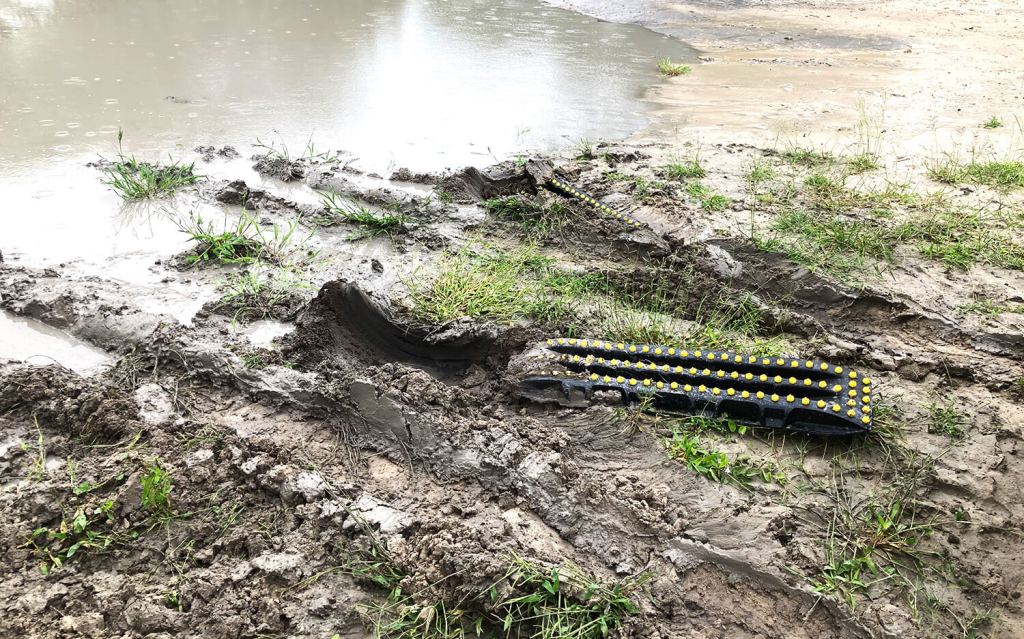
In Maun, we find a great auto / camping shop where we buy a cargo net and sand tracks. Sand tracks are basically very sophisticated planks made of a strong composite material and studded. The idea is that if you get stuck in sand or mud that you wedge the track under the tyres and then drive on out using the hastily fashioned ramp. The studs on the tracks provide traction for the vehicle’s tyres. We want a go-to recovery tool which doesn’t need rolling out the winch and hoping for a sturdy enough tree like we did in Chobe National Park earlier in the month.
Places we found in Maun in the few hours we were there:
- Riley’s Garage Auto Zone – Stocks a lot of tools, equipment and parts that a 4×4 overlander will find useful.
- Shell fuel station – Next to Riley’s Garage
- Beef Boys butchery – Next to Riley’s Garage with good value and prices
- Purified water refill – A few minutes drive South along the main road (Tsheke Tsheko road) from Riley’s. In between Ellerines and Sefalana Shopper
- Toyota – Even further down Tsheke Tsheko road (going South from Riley’s)
We buy all of our supplies in short order but struggle to find some vegetables due to a recent Botswana ban on import of fourteen types of vegetable. The government is reportedly trying to make Botswana less dependent on other countries.
Heading out of town I realise that the day has taken its toll on me and I am tired. The camp is only ten kilometers outside of Maun so I don’t worry about it and decide to drive the rest of the way. An error which I will regret later.
The turn off for the camp off of the A3 arrives fairly soon after leaving Maun. Maps.me has been programmed to follow the iOverlander GPS co-ordinates to Sitatunga Camp. We have not bothered to make a pre-booking due to low Covid occupancy numbers to date.
The route is a typical Botswana sand track. Very fine or loamy and easy to sink into. There is however a significant hard surface under the soft layer and so I’m not unduly concerned in my tired state. Fairly soon we run into some big puddles along with many diverging tracks. I engage 4×4 high range and skirt around or over the edges of the increasingly larger puddles keeping as close to the GPS route as possible. Each major puddle we come to has a branching track just before it which I take to avoid the potential mud barrier before us. And then we came to an impasse.
Not paying as much attention as I should have been on the next move following, I ford a fairly significant puddle with a good deal of cloying mud only to find us in between two very large puddles. My options are to reverse through the puddle I had just come through or to drive full-steam through the puddle ahead. I’m not keen on going backwards as we are back heavy. I don’t think we would get as much momentum going backwards as we might going forwards.
I opt for the forge ahead scenario. My next choice is whether to cross on the left, middle or right of the puddle. The left and middle are all puddle. The right hand side is “shallower” with some mud showing and what looks like previous vehicle tracks just under the surface of the water. So without any further thought and still in high range, I back up a little and then shoot forward looking forward to a cold beer on the other side.
We are stuck in that ten metre long puddle for what feels like hours. I am tired and very grumpy. The vehicle is at a vertical angle of about fifteen degrees with the rear part lower than the front. The exhaust pipe is submerged in the water spluttering and bubbling away. I have lost my flip-flops in the mud almost immediately and am walking around bare foot uncertain of what I might stand on under the water. The rear mud guards have somehow wrapped themselves under the tyres or at least between the tyres and mud behind. This situ we have settled into makes gaining traction difficult. It is very difficult to deflate the rear tyres now.
At this point I should say a few things. Things that I should have done differently before getting stuck:
- I shouldn’t have been driving tired even if it was just a short distance
- Deflate the tyres as soon as things look like they might get a little sketchy or if you’re driving on a sand track. We had only a kilometer to drive and this got us
- If in any doubt, always walk the puddle before going through it unless you are in a national park with dangerous animals. Your traveling companion is there to hop out of the vehicle and do a quick splish-splash through to gauge the difficulty
- Engage low range 4×4 before you get stuck in a situation. Low range is your friend in tight situations but can (sometimes) cause more problems by digging you in deeper once stuck
- Don’t go to low range to get out of being stuck unless you’re fairly sure it’s the right move
We try digging our way out. No result. We try reversing and then going forwards. No result. We try digging our way out and using the brand new sand tracks. No result. Very disheartening.
Finally, we turn to the nuclear option. The winch. My trusty companion (Kirsty) holds the remote whilst I pull the cable out as far as it will go. I get nowhere near a tree. So I wrap the tree-hugger around a bush approximating a tree and link it all together. For dampeners, I curl the unused recovery strap around the cable a few times and add an empty 20 litre water bag on top. I pop the bonnet open and secure it up as if going for a service to provide another shield in case anything comes flying back towards the windshield and driver. I caution the recovery companion to stand well back and to the side whilst using the remote.
We are stuck deep so I have to allow the winch to take the bulk of the responsibility with the engine and gears in support. With instructions to my recovery companion to keep the button on the winch remote depressed unless I shout we begin. With a lot of swearing and begging with the smell of a burning clutch that lovely little shrub proved that it had every little bit of the qualities needed to be a tree and with a tired lurch we are out of the bog.
We arrive at Sitatunga Camp. We are both mud-splattered and tired from racing the rain showers for the past two days and so request two nights to give us some time to relax. The camp is well designed with a surprisingly well-stocked restaurant and bar. The showers are strong and hot which quickly improves the mood. Each campsite has either a corrugated tin or thatched lapa roof and the thatched lapas have private en-suite. There is also a very decent swimming pool. And they have pizza!
Awesome stay! On the last night, some poor Toyota Hilux owner had his alarm going off every 20 minutes. We have noticed a few times during the travels that the only alarms which seem to go off in campsites are the Toyota Hilux and Fortuners. We used to set ours off intermittently at the beginning also causing a mad scramble for the keys in the roof tent. It sucks being in the middle of the wilds of Africa and suddenly becoming those people.
There was also a fairly tense situation at the bar/restaurant that night when a self-professed Irishman tried to hold on to my hand physically after I had been polite enough to shake it. I had popped in quickly to grab a beer each for the campfire. I just chatted away with him until he released his grip and then left to sit around our campfire. He insisted on me knowing that his name was “Connor.” I prefer to think of him as “Moron.” Travels so far have shown that defense is usually better than offense in these situations. Defense will hopefully keep the night going. Offense will end it abruptly one hundred percent of the time. He was probably that noob who left his Hilux alarm ringing through the night.
 The Colour of Travel
Leave a comment